Hysterical Choir of the Frightened (HCF, 2014)
Single-channel digital film projection, 16:9, 3 min 45 sec
On 25 January 2014, people gathered in Tahrir Square to mark the third anniversary of the Egyptian revolution, the first since the military coup of 2013. Only supporters of the army’s actions were admitted into a heavily surveilled square. Meanwhile, opposition marches organized by the Muslim Brotherhood in surrounding neighborhoods turned into massacres.
The proximity of celebration and killing led journalists to call it “the day of death and dance.” On 26 January, journalist Wael Abdel Fattah began his column with the words: “Jihadi madness versus the hysterical choir of the frightened.” (almogaz.com, January 26, 2014)
The idea for HCF emerged from an attempt to deconstruct this phrase, not only as a paradoxical instance of revolutionary rhetoric, but as a reflection of how language shapes agency, responsibility, and authority. The sentence casts both sides of the revolution as masses driven either by fear or fanaticism, culminating in the dramatic juxtaposition of death and dance. In deploying these terms, the phrase strips the crowds of responsibility, reason, and self-governance. This textual denial of conscious agency effectively removes both revolutionaries and counter-revolutionaries from history. It implies that to return to history–to reclaim responsibility and participation–one must first accept death as the ethical threshold of sacrifice and individual accountability. Death becomes the gatekeeper of meaning, of ethics, of agency.
Hysterical Choir of the Frightened (HCF) imagines a counter-force to the rhetoric that strips political crowds of agency. It stages a feminine authority—calm, composed, and accountable—who refuses hysteria and reclaims the right to meaning. Four women form a choir, quietly reciting passages from the Marquis de Sade’s Justine (1791), where killing is defended as natural: through murder, suicide, or state execution. Their synchronized voices resist the noise of the crowd, exposing how ideology scripts both violence and obedience. By invoking de Sade, HCF conjures the horror of the French Reign of Terror to mirror the 2014 massacres in Cairo—where revolution was celebrated atop the corpses of the Islamist opposition. In this staging, madness is not a loss of reason but a strategy of survival—a lucid confrontation with the ethics of power. HCF was commissioned by the 36th EVA International–Ireland’s Biennial, AGITATIONISM.
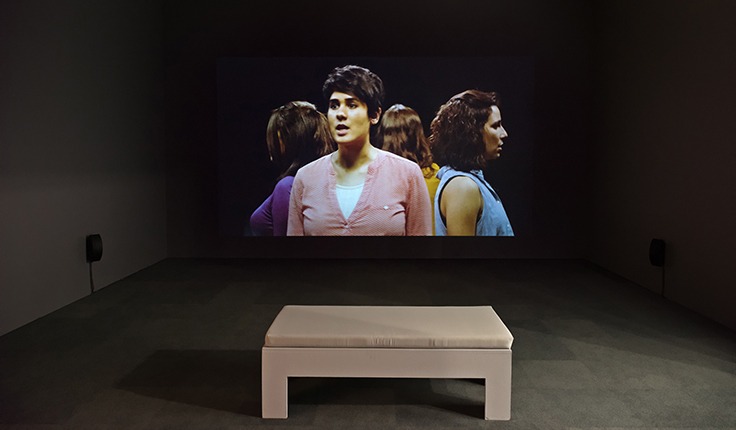
Hysterical Choir of the Frightened
Digital film, 2014, 16:9, 3 min 45 sec