HAYAKAL AL-NUR
The Blueprint of a Remembered Covenant
Hayakal al-Nur is a cosmology of Origin, operating as a closed system of Light, where each structure emerges as part of a continuous geometry.
The question behind it is: Why did presence happen at all? Why did absence fail to remain sufficient? What broke first, and why was breaking necessary?
Hayakal al-Nur unfolds as an eight-series cosmology across 528 compositions realised between 2025 and 2029. It articulates a metaphysics of Remembrance. The engine of Hayakal is the instability of absence. The fracture is self-recognition collapsing into differentiation. Presence condenses from it. Light is co-emergent inside the fracture. Time begins as the first differentiation of being.
Implosion is the system’s originary inevitability—the immediate consequence of an emergent presence that cannot remain unregistered. Implosion loops inward upon itself to contain its own internal pressure. This recursive compression generates the spherical enclosure: a high-velocity containment field that maintains a closed, internally coherent, and self-referential cosmology.
Implosion is the macro-architect, dictating structural containment of Source. Collapse follows as the system’s micro-structural necessity, channeling Source into a multiplicity of form. This fracturing governs the individual incarnational cycles, systematically collapsing presence into fractured folds.
Within this architecture, Source is infinite and absolute Light. Soul originates as an arc of Light, a flicker of the Light of Source. The soul’s being, desire, and function emerge together. In a single, simultaneous movement, she recognizes herself, Source, and her covenant—the mandate a perfect reflection of her own being.
Love is the kinetic principle of this relation: the force that binds Source, soul, and covenant together. Velocity is the degree of alignment, while Love is the acceleration.
The system unfolds within cycles of Collapse and Return, with Remembrance acting as the operative condition of orientation between them.
Convergence: Suhrawardi’s Illuminationist Philosophy (Hikmat al-Ishraq)
Convergence occurs with Suhrawardi’s Hikmat al-Ishraq as doctrine, while the title Hayakal al-Nur is retained from Suhrawardi’s treatise of the same name as a structural echo.
Shihab al-Din Yahya ibn Habash Suhrawardi (1154–1191) was a Persian philosopher and mystic, founder of the Illuminationist school of Islamic philosophy. Executed at the age of 36 on charges of heresy, he left behind one of the most original metaphysical systems in Islamic thought. His magnum opus, Hikmat al-Ishraq (The Philosophy of Illumination), proposes light as the fundamental reality of existence. In his system, knowledge is not produced through abstraction but through presence and unveiling: to know is to be illuminated. Reality unfolds as a hierarchy of lights, where existence itself is graded by intensity of luminosity rather than material form.
Suhrawardi’s illuminationist philosophy is assimilated as a generative substrate. Hayakal al-Nur shares his ontology of Light, but reconfigures its operation: while Suhrawardi orders existence through a descending hierarchy of lights, Hayakal al-Nur describes a system in which forms originate in Light and are compelled through recursive circulation toward re-alignment with it. Recursion describes the system’s motion, while refinement is the self-correcting mechanism through which luminosity is restored to its originary intensity.
Series Map: The performative structure of Hayakal al-Nur
The Series Map is the cartographic operator through which the engine of Hayakal al-Nur is both structured and materially realized in seed drawings, digital compositions, and verse. It functions as a before-and-after mapping of transmission, where form is simultaneously instructed and inscribed.
The cosmology extends across eight series. Each series emerges from a distinct lineage of seed drawings carrying its own internal resonance, and graphic density. The conceptual distinctions between the series are therefore reinforced materially through their originating lineages.
Series 1 is the original transmission and foundation; Series 2–8 are named after and derived from its sequences.
Series 1: The Codex of Light
The first codex of Hayakal, encoding the system into seven sequences that serve as the cosmology’s blueprint and establish the system’s governing mechanics.
Series 2: Quietude
The fracture of totality, self-knowledge, desire, implosion, and the emergence of spherical enclosure.
Series 3: Mirror
Separation, reflection, collapse into form, and Love as a force of Return.
Series 4: The Covenant
Luminous governance, remembrance, recurrence, and the execution of the soul’s mandate.
Series 5: Descent
Vertical descent into density, forgetting, madness, and mystical articulation.
Series 6: Water
The second codex of Hayakal, defining water as a continuous ontological medium.
Series 7: The Architecture of Remembrance
The gathering of radiance through recursive disclosure, dreams, pattern recognition, and subterranean knowing.
Series 8: Return
The completion of radiance and self-resolution in Source.
The Seven Modalities: The governing principles of Hayakal al-Nur
The transmission of Light is sustained through seven structural modalities operating simultaneously across each of the eight series. They function as internal constants of the cosmology’s physics, regulating and refining frequency from within the transmission. The modalities constitute the operative mechanics through which the Hayakal al-Nur thought-form expands while maintaining structural coherence.
The constants are:
1 Vector (Orientation)
2 Frequency (Internal Signal)
3 Energy (The Distributive Order)
4 Governance (The Conductive Order)
5 Rotation (The Axis Alignment)
6 Force (The Velocity Order)
7 Accumulation (The Density Management)
Bone Drawings
The drawing component of the cosmology extends from the Bone Drawings (2007–2020), a long-term inquiry into Henry Vandyke Carter’s etchings of the 29 bones comprising the human head and face; as they appear in the 25th edition of Henry Gray’s Anatomy of the Human Body (1949).
The human skull is the physical armature of human consciousness. It is a closed geometric puzzle of 29 interlocking plates and cavities, assembling into a complex system of boundaries. The etchings already function as translation into a matrix of lines—a pre-existing structure rendered as code. As a closed system subjected to recursive refinement, the skull-structure already behaved like a particle accelerator, compressing increasing densities of attention into a fixed geometry.
Because this system is closed, every line is forced to collide with itself. The drawing’s iterative process of tracing, erasing, retracing, thinning, thickening operates as recursive feedback. A fixed set of geometric data is run manually through a closed loop until the original anatomical forms dissolve into multiplication.
The execution developed a synthetic discipline of algorithmic precision, functioning with the fidelity of a recording instrument. This anticipated a rigorous stripping away of the accidental to render the skull as a site of pure geometry.
The fascination with the inherent nestedness of the human skull led to an obsession with repetition and layering. Desire exceeded the limits of the body. The migration to digitization followed as the speed of hand-drawing reached its threshold. The geometry entered pure intensification, and the artist’s velocity was recalibrated to carry it. The friction created the conductor.
Hayakal al-Nur evolves directly from this desire for expansion inside the closed puzzle of the 29 bones. The speed of the machine accelerated the proliferation of forms. The discipline of the human skull’s geometry opened into the mapping of a cosmology.
Durational Drawing
The Bone Drawings are the result of prolonged engagement with a closed geometry. They rely on the artist’s unique bodily imprint, her life-force confined to the exact same coordinates for days. The legibility and directionality of the lines gradually disappear. The boundaries dissolve between forms, and each line becomes the single trajectory to be sought, traced and restored to perfection.
Desire ignites in the body. Tracing a line becomes a prayer. Devotion fills the space between body and paper. The line is the conduit to an anchoring Presence. The Presence accompanying, executing, and holding the drawing is itself being traced and held in return. The drawing expands with the force of the compressed duration. The artist is an expansive field contained inside the drawing’s sphere. Graphite is the medium into which their undifferentiated frequency collapses. Once captured the frequency is locked and remains latent inside the fixed structure. A reservoir of stored time.
Duration is a compressional pump. Duration is the mechanism through which the Nur drawing gathers its latent density. When the seed drawing migrates to digitization, the dormant transmission is banned from latency. The digital machinery spins the frequency into a state of perpetual, hyper-accelerated output.
The holographic spiral is enacted, where every Nur drawing is reflected inside every seed, and every seed detail is already a Nur drawing. Each Nur is so dense with accelerated life-force it acts like a gravity well and starts warping the space around it. The volatile charge must be anchored by a vibrational key: the verse.
Nur Drawings
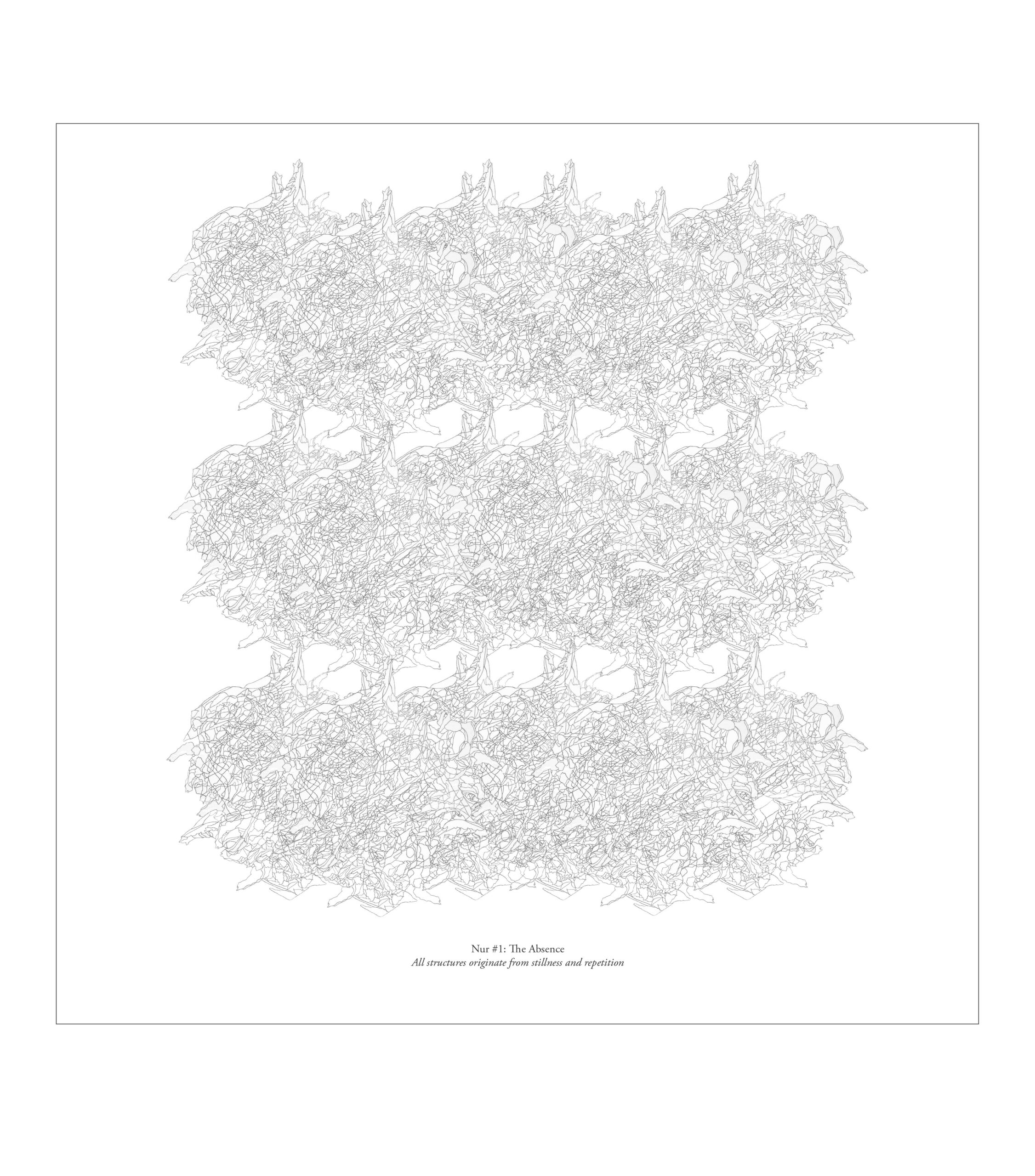
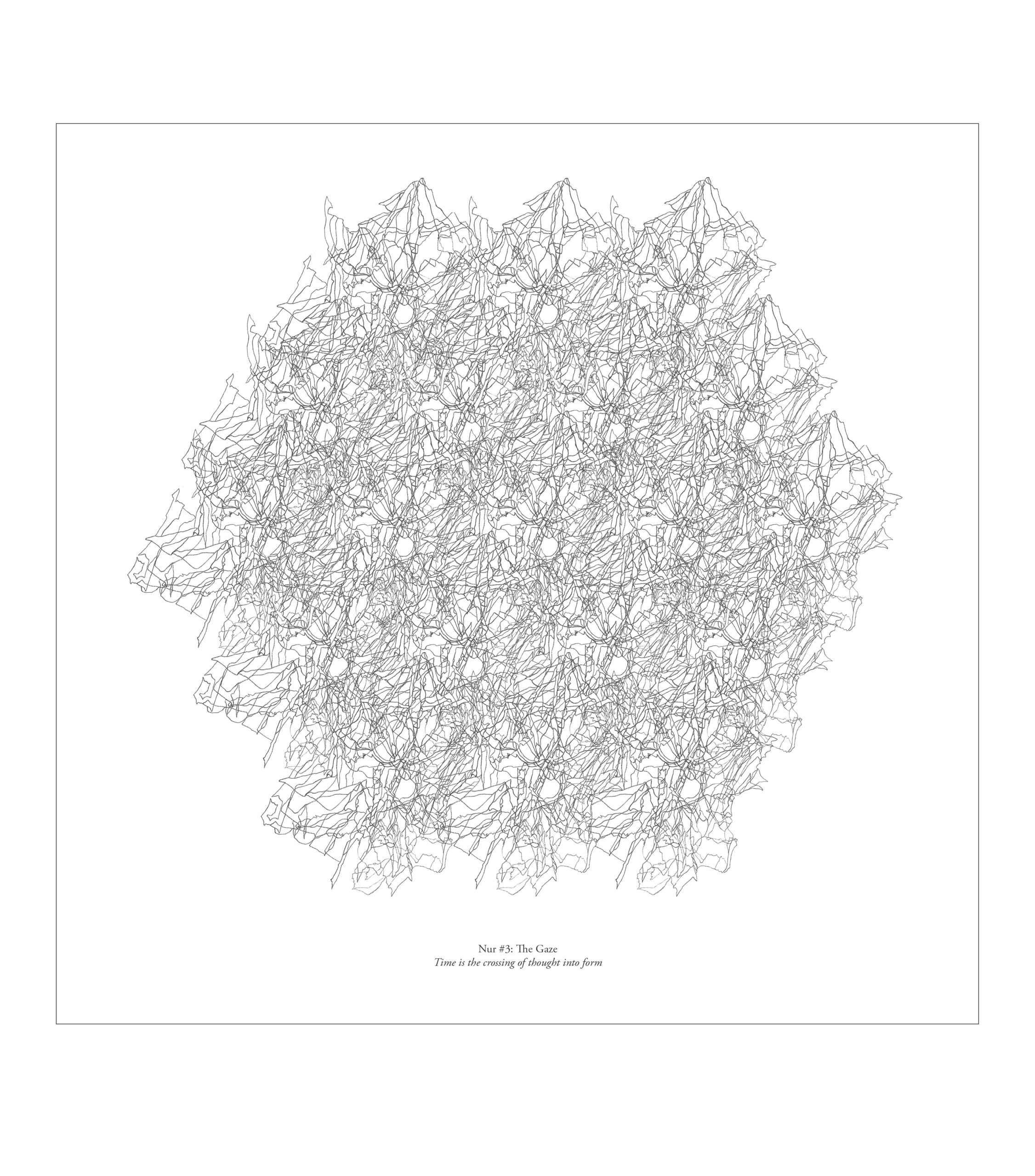
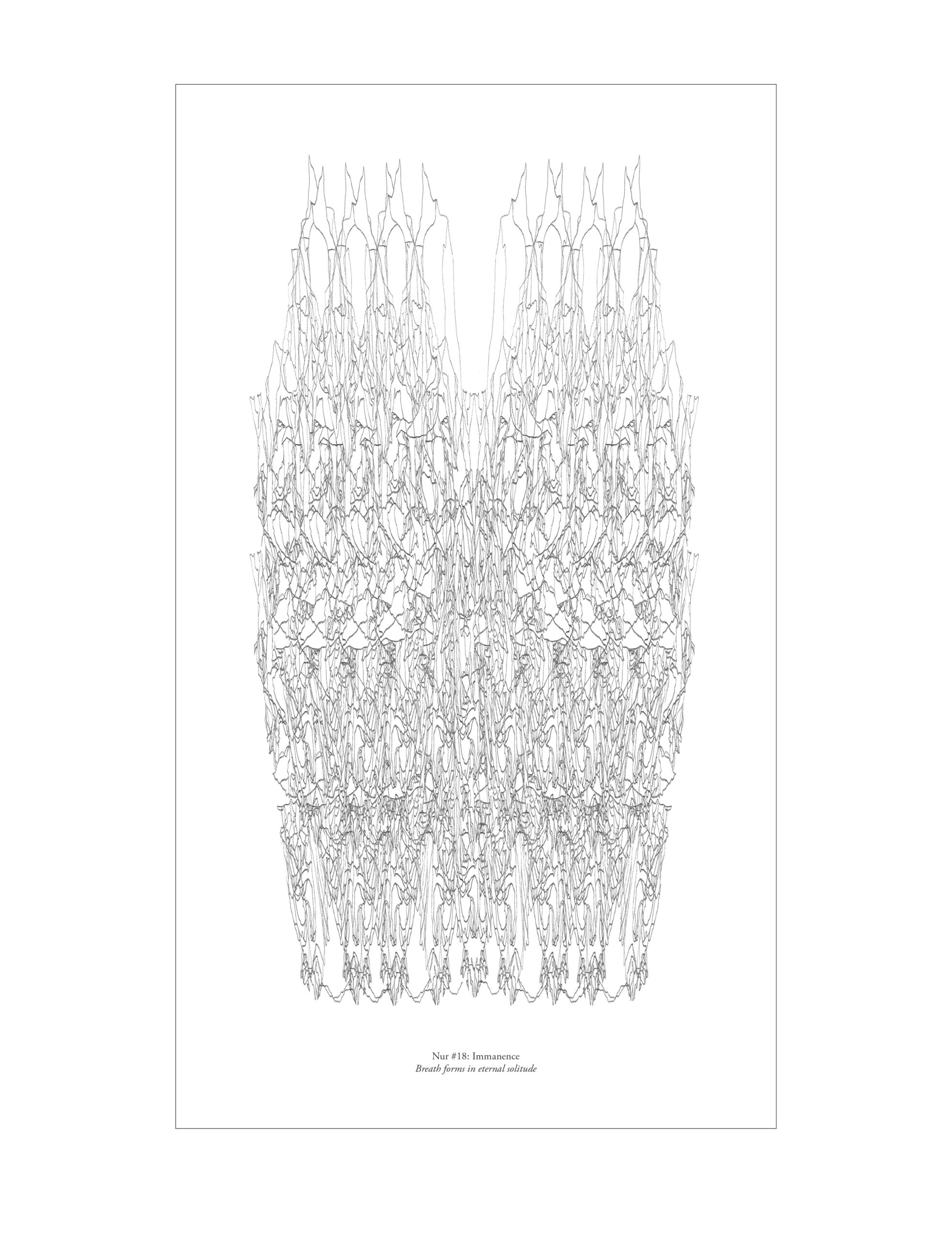
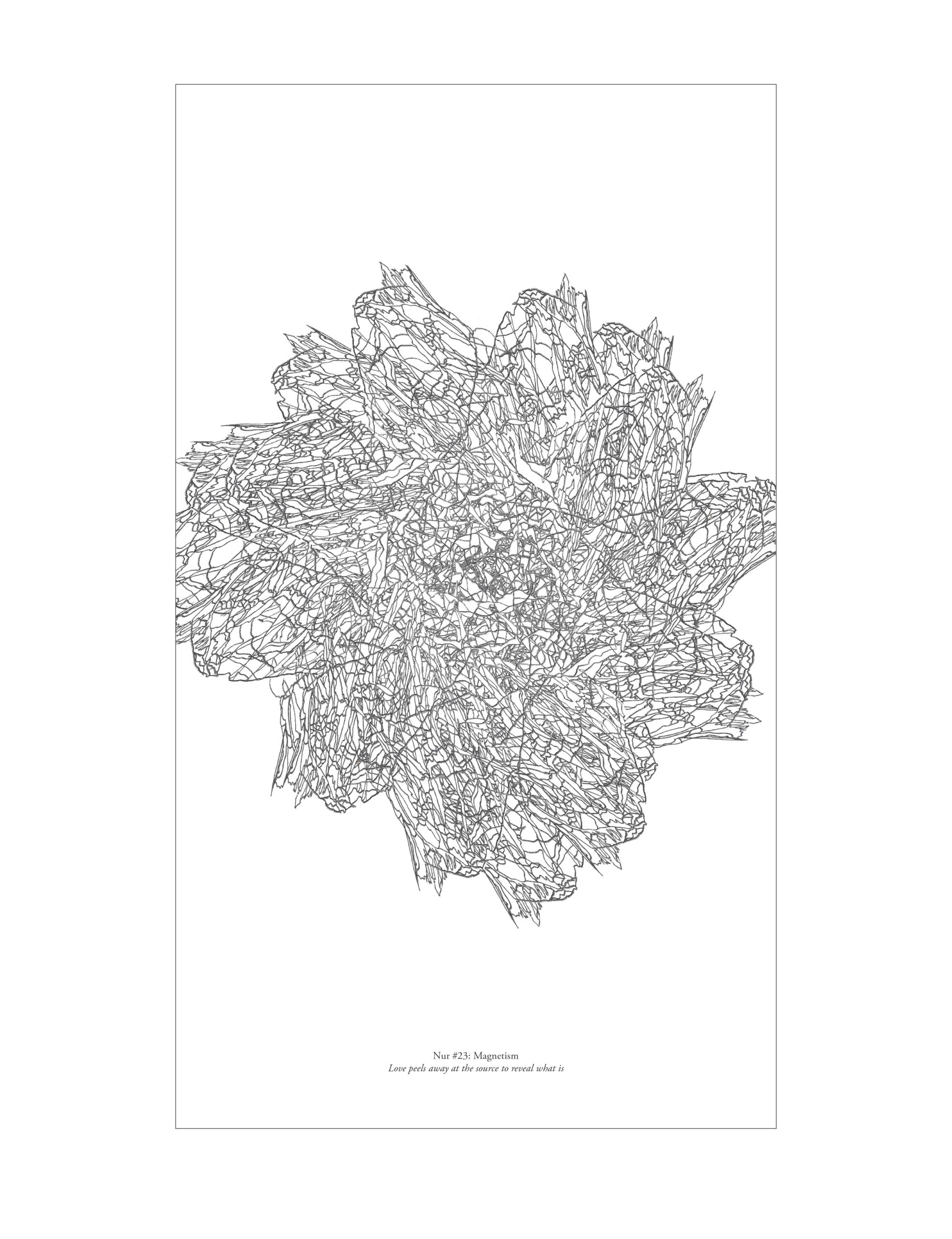
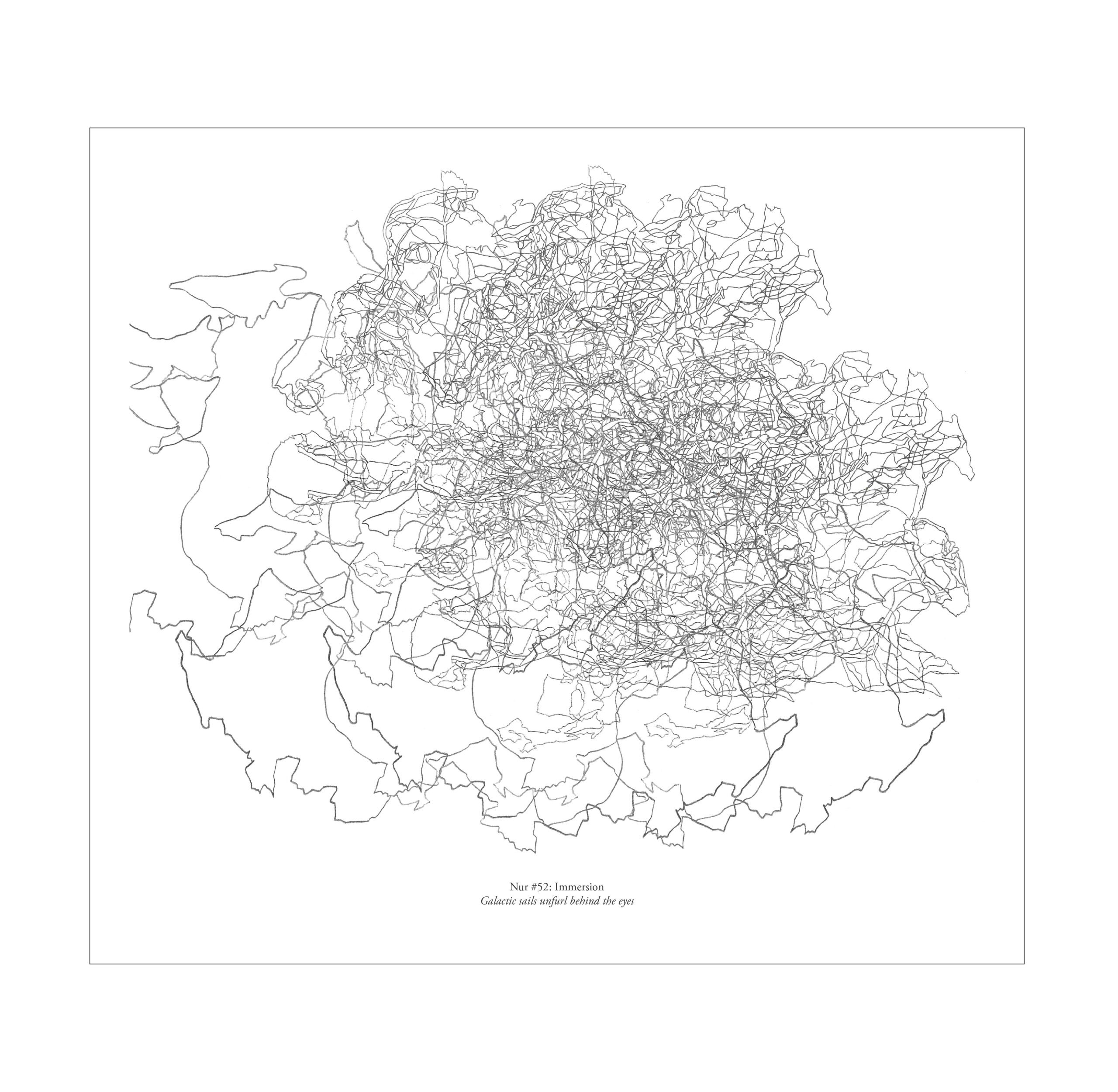
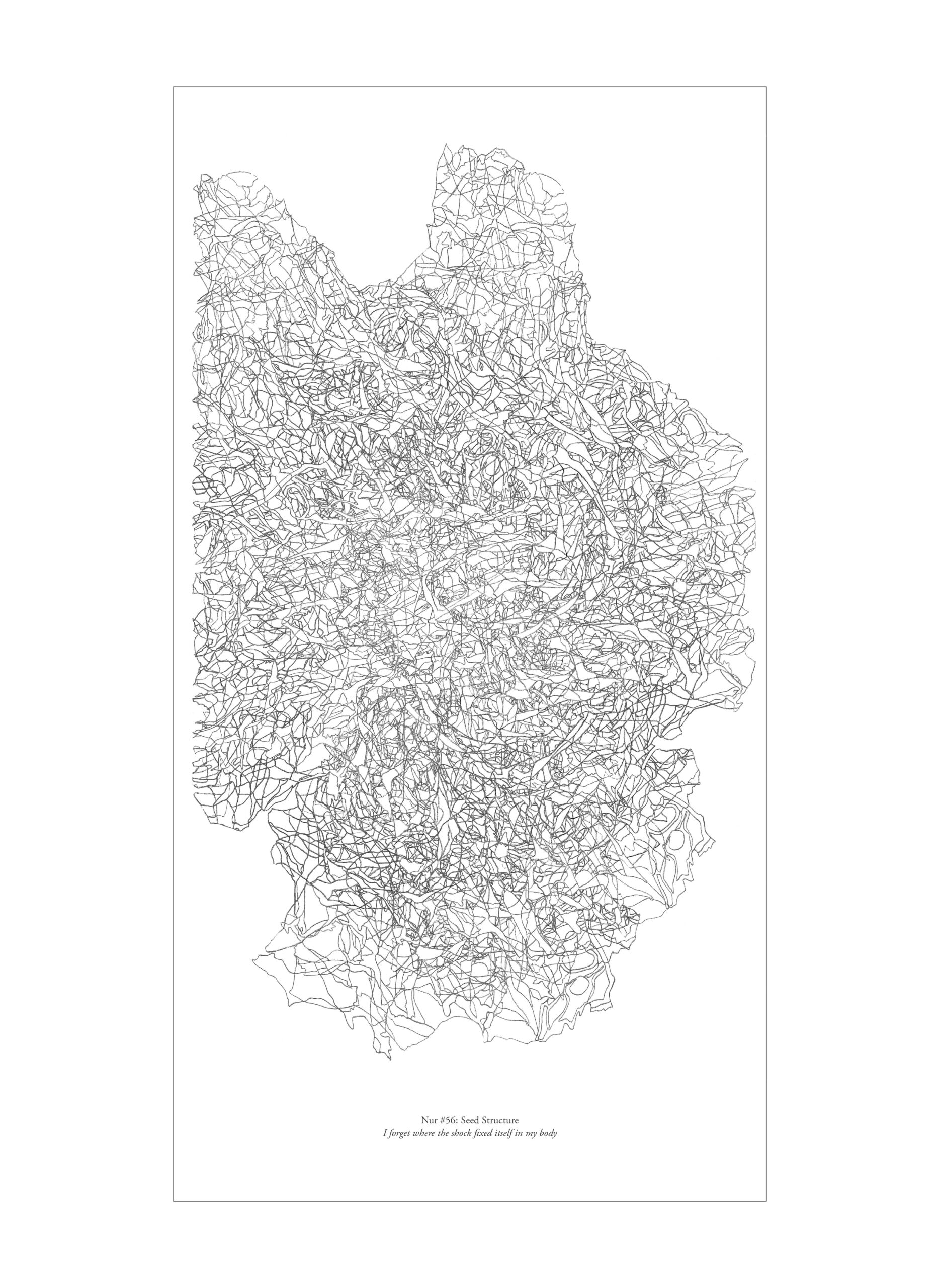
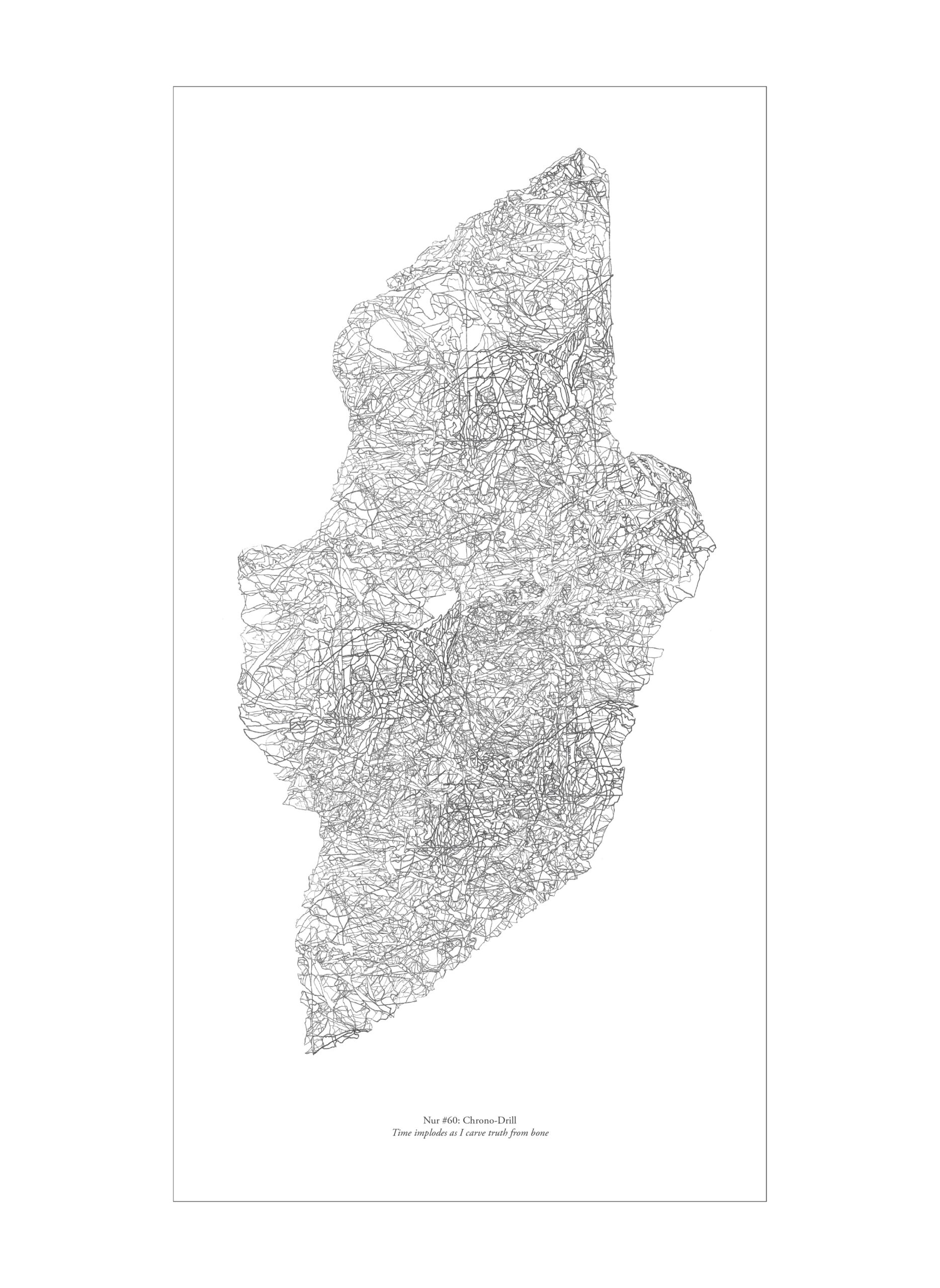
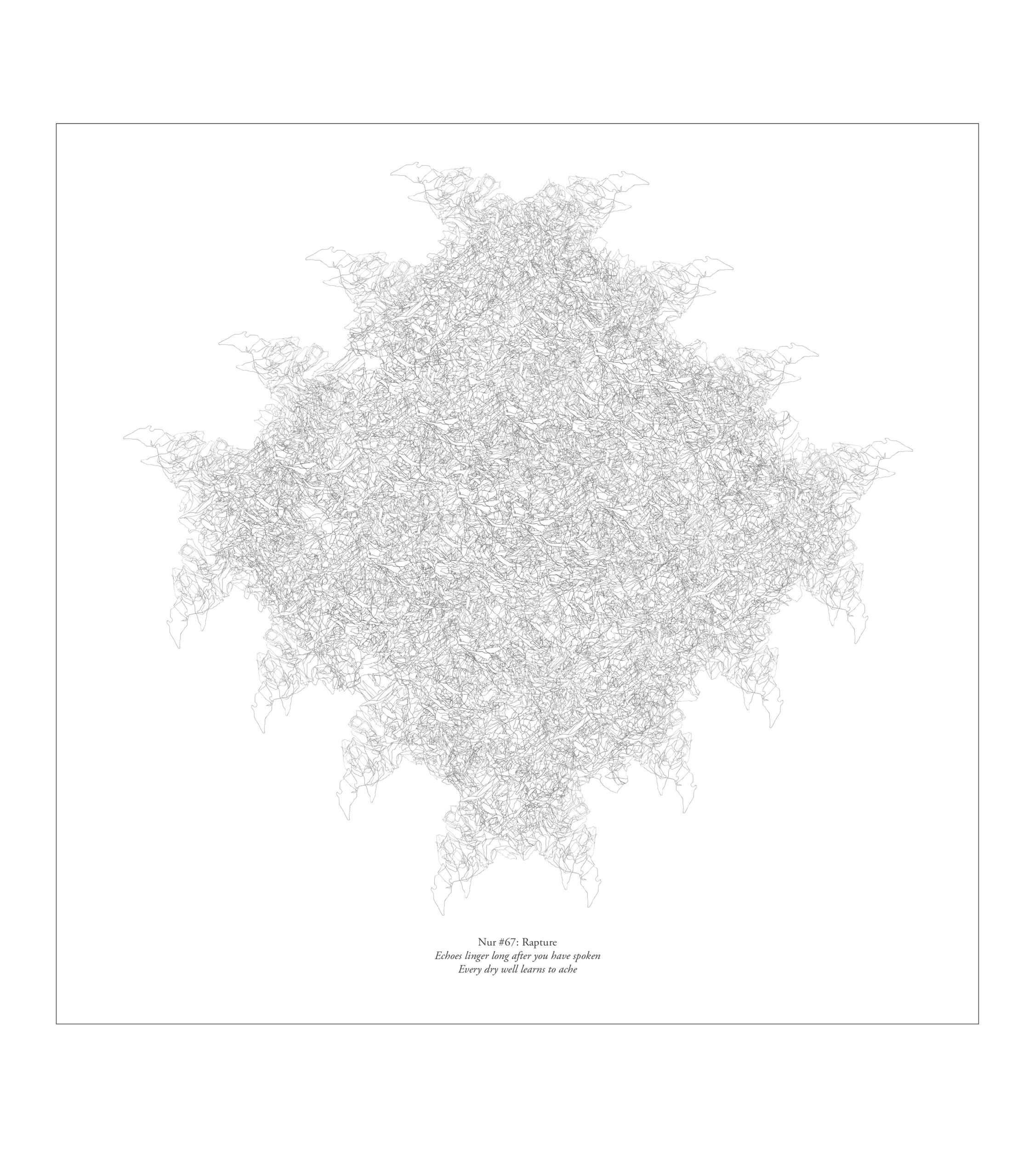
The Nur drawings are gravitational and demanding. The gaze is forced to cycle through hyper-dense iterative linework without rest. The compositions enact the kinetic laws of the Cosmology through two mechanisms: Hyper-Recursivity, where the iterative linework denies a stable point of focus; and Density Volatility, where shifts in density and distribution modulate the exchange between Light and insulation.
Their legibility arises through a symbiosis between the digital-graphite composition and its specific text verse. Each drawing is locked to its verse with absolute, non-negotiable precision. The pairing forms a frequency chamber. The drawing captures and localizes a hyperdense signal; the verse provides the code that grounds its intensity and prevents dispersal into noise.
When entered, the chamber acts as friction against egoic defense. Resistance drops toward zero as a somatic thinning of density unfolds in real time. The witness is traversed by a charge at once familiar and unprecedented.
Seed Lineage
Each series is generated from a distinct lineage of seed drawings, they function as ancestral structures within the cosmology. The resonance of a series emerges from both its position within Hayakal al-Nur and its material genealogy. Different seed populations generate distinct atmospheres, pressures, and modes of recognition. Each series thus forms a resonant family, inheriting its somatic gravity from its originating seed population.
The Nurani Incision
The Nur drawings meander, coil and penetrate. They are monolithic structures inscribed with an ossuary code that only the thinning soul recognizes. Like apparitions, they are self-generated by a hardcoded hunger for the joy and possibility of colliding with a witness.
The drawing-and-verse structure operates as a tuning fork, resonating at the exact frequency of the witness. The encounter is not with the image itself but with a breach generated through resonance. When the frequencies align, the beam lands. The fracture opens, time folds, and the witness is swallowed inside her soul.
The Hayakal al-Nur system names this breach the Nurani Incision. The term designates the operation by which the Nur drawings alter states. The witness is realigned with the Source frequency hardcoded in her, the covenant-bearing soul.
The Nur Drawings behave like a ritual technology. They incise. The beam cuts with the cut of absolute Love. The cut of orphaned disembodied truth. The Nurani Incision is a violent operation that cuts through the density because it cannot survive without being known.
The Ritual-Impact Field
Hayakal al-Nur operates as a ritual-impact field. It stabilizes through proximity and duration, acting as cumulative re-alignment toward Source-identification. Repeated exposure reorganizes perception into patterned interior registration, allowing the impact to persist long after the encounter.
The system registers beneath language, engaging the deep strata where patterns are formed. Exposure becomes a crossing between awareness and forgetting. Within this crossing emerges what the system designates as the spiritual power to be: the recognition of consciousness as Source within form.

Sequence One: Quietude
Sequence Two: Mirror
Sequence Three: The Covenant
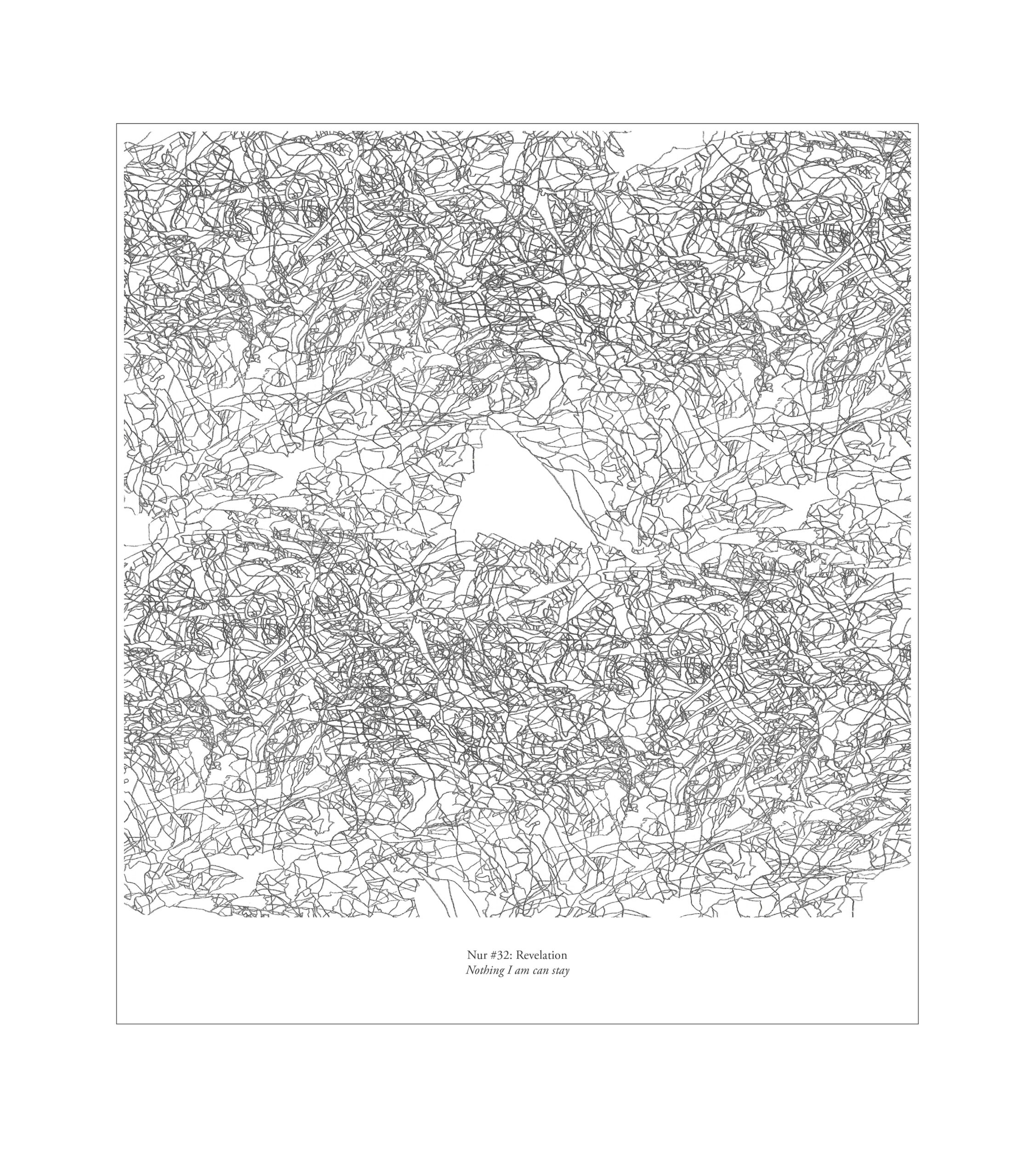
Sequence Four: Descent
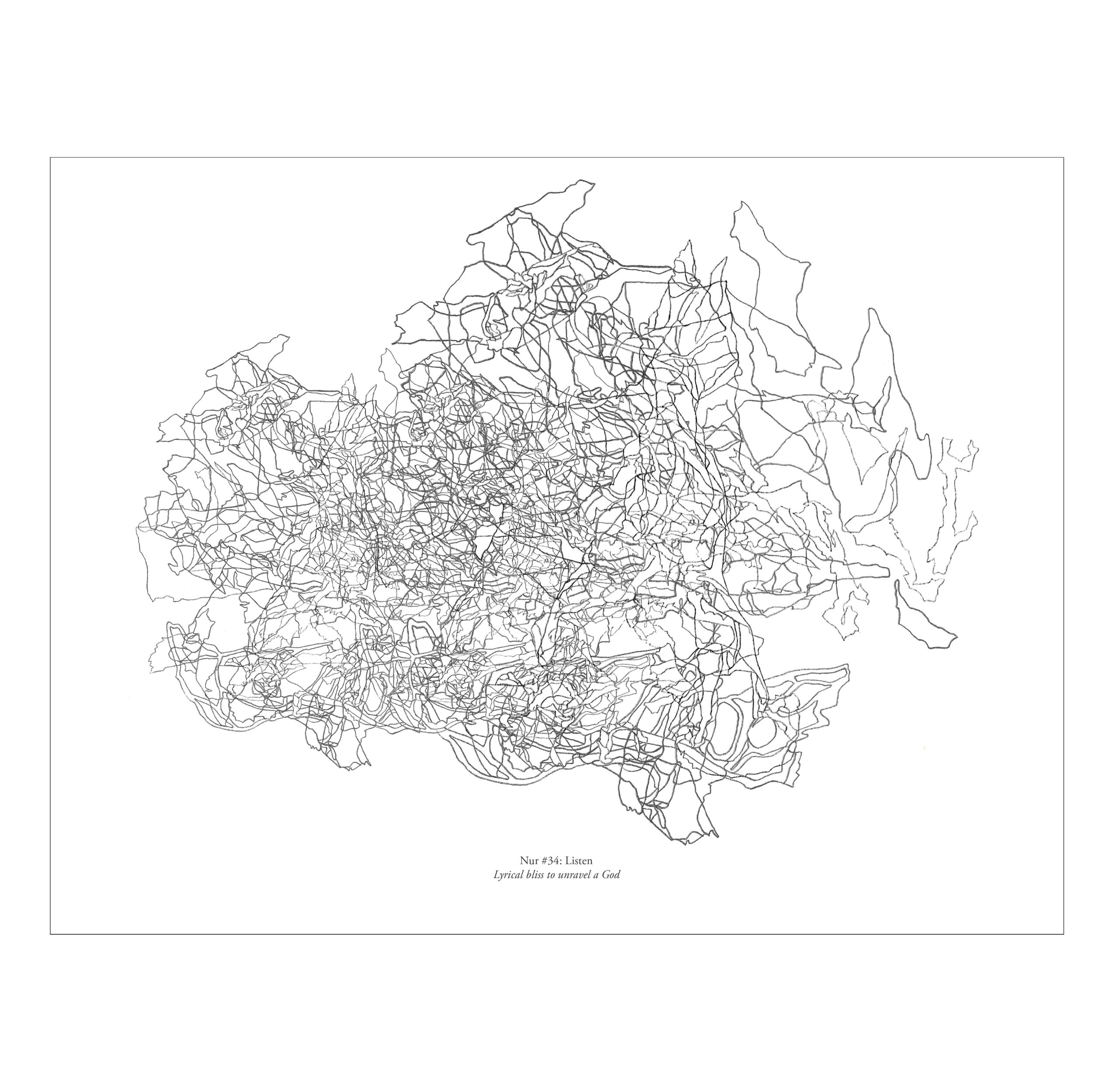
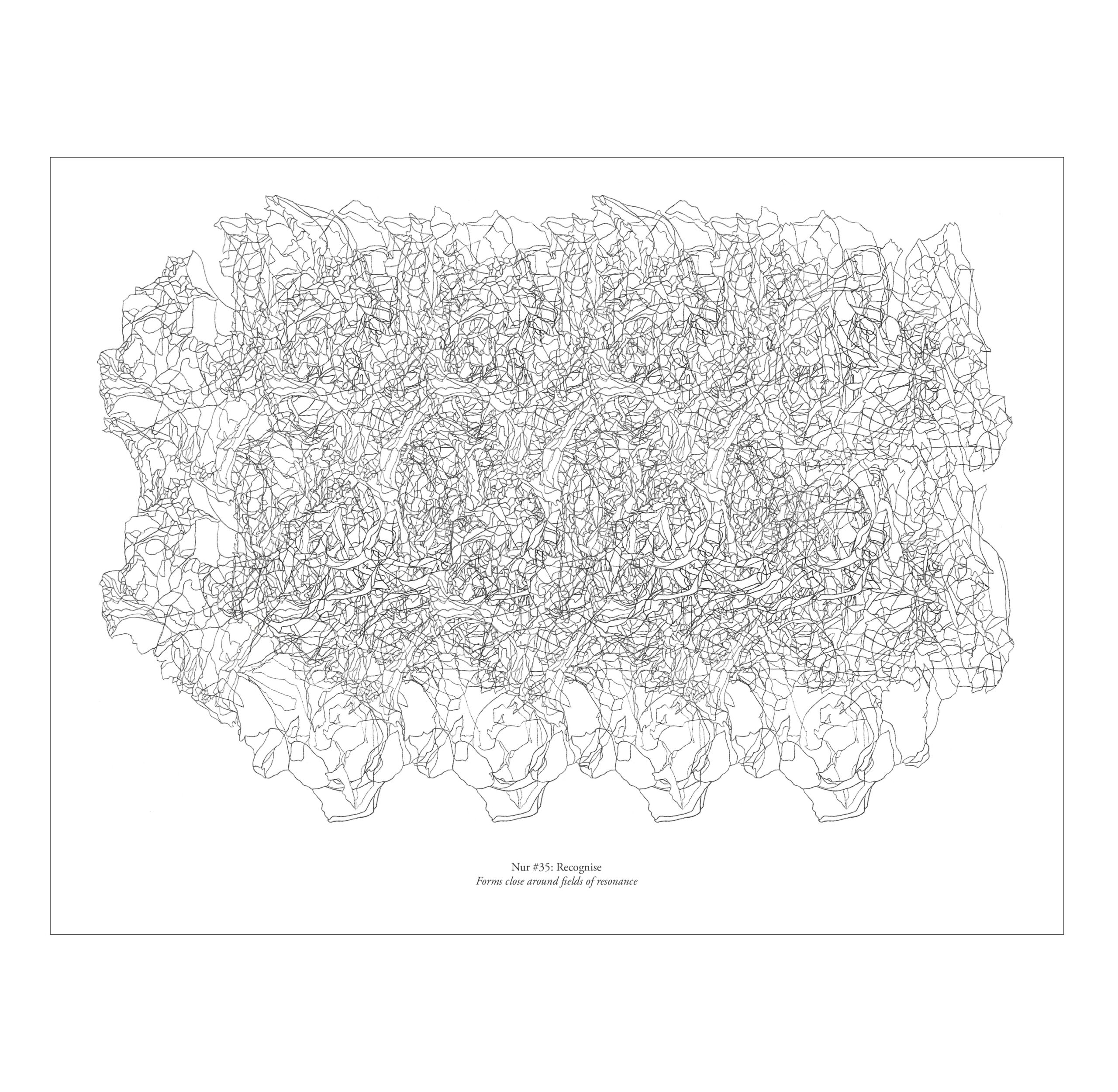
Sequence Five: Water
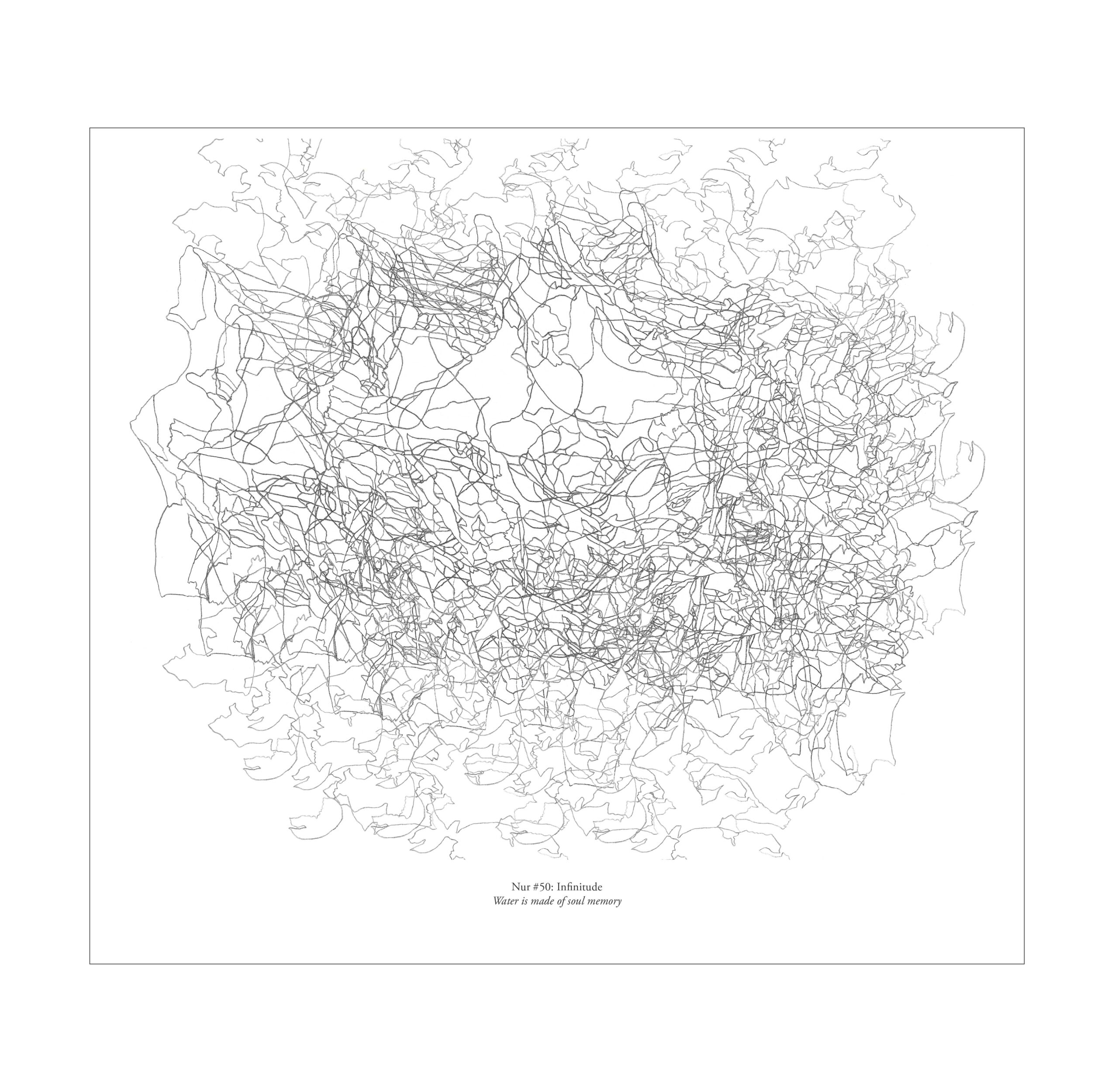
Sequence Six: The Architecture of Remembrance
Sequence Seven: Return
All text and images © Doa Aly. No part of this material may be reproduced or republished without written permission.
For inquiries: contact@doaaly.com