The Girl Splendid in Walking: Redux (2025)
Single-channel video with voiceover narration, 16:9, 19 min 17 sec
A reimagined invocation of absence, gesture, and return. This single-channel redux of The Girl Splendid in Walking (2009) breathes new life into the original installation, threading voice and image through the ruins of memory, movement, and desire.
The film is a choreographic meditation on Gradiva: A Pompeiian Fancy (1902), a novella by Wilhelm Jensen. In Jensen’s text, archeologist Norbert Hanold becomes obsessed with a bas-relief sculpture of a young woman caught mid-step. He names her Gradiva—“she who walks”—borrowing one of Mars Gradivus’ epithets. Hanold dreams of her walking through Pompeii just before the eruption, and, haunted by her posture, travels to the ruins to find her. There he meets a woman he believes to be her ghost, only to discover she is Zoe, his childhood friend, whose walk had been burned into his subconscious and mythologized as Gradiva’s.
The film explores the hallucination of form, the magnetism of gesture, and the architecture of longing. The sculpture’s impossible walk becomes a site of projection. Gradiva’s gait—a strange forward-crawling movement followed by a sudden release—suggests a mythical motion, divided and asymmetrical, but miraculously poised in its center.
These qualities of movement, coupled with the temporality of walking—time elapsed, distance crossed—form the basis of a choreographic interpretation. Time in the film is porous: the sun’s glare, archeological ruins, and the characters’ rituals all function as thresholds between presence and absence. The camera lingers on moments of stillness and repetition, evoking a suspended temporality where memory and desire collapse into one another.
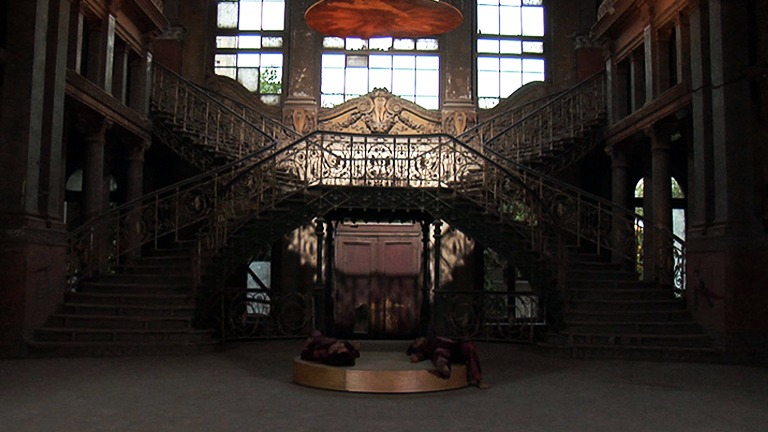
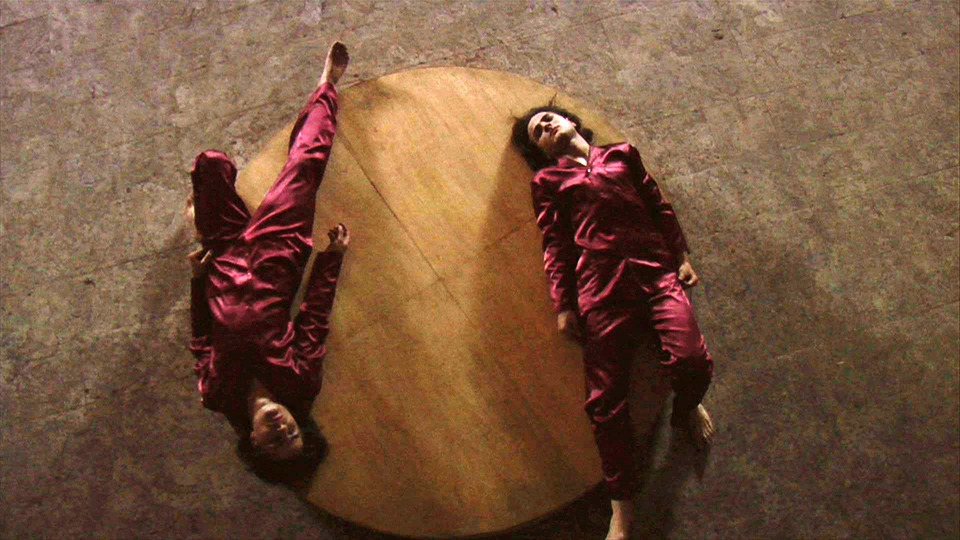
The four figures—Zoe and her ghost Gradiva, the archeologist/hypnotist, and the twin craftsmen—are bound by invisible threads: hypnosis, dream, longing. The archeologist performs a ritual to resurrect Zoe, teaching her to move through pantomime. She follows the sun through the windows of a deserted apartment, while Gradiva, her double, roams the edges of an ancient palace. The twin craftsmen, imagined sculptors of the bas-relief, appear as sleepwalkers. They create a marquetry portrait of “she who walks” and affix it to the ceiling, circling beneath it each day in silent devotion.
In this redux version, voice becomes presence. The narration weaves through the image, animating and re-encountering the original textures of the film. The Girl Splendid in Walking: Redux is not a return, but a re-entry: a lingering at the edge of absence, a slow crossing toward the memory of form.
The film was originally commissioned by the 11th Istanbul Biennial: “What Keeps Mankind Alive?”, 2009.