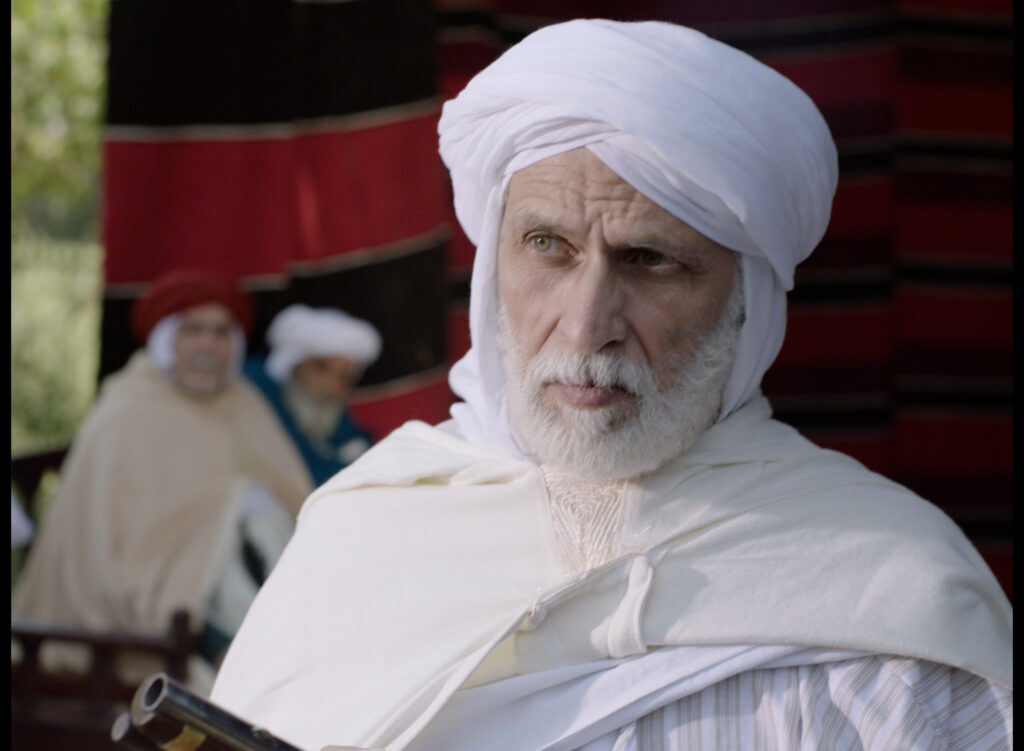
The Day God Imploded (2025)
Five-channel synchronized digital film installation
The Day God Imploded is a five-channel audio-video installation adapted from two literary sources: Jean Eugène Robert-Houdin’s Confidences (1858; translated in 1859 as Memoirs of Robert-Houdin) and Albert Camus’s novel L’Étranger(1942; translated in 1946 as The Stranger). The first and second scenes recount how a stage illusionist was enlisted to suppress Muslim resistance in French Algeria. The third depicts a random act of colonial violence: the unprovoked killing of an Arab man on a beach in Algiers.
In 1856, the French government deployed Robert-Houdin to Algeria to discredit the magical authority of the Aissaoui marabouts, whose rituals had galvanized anti-colonial resistance. His mission was to perform illusions that would terrify local tribes and assert the supremacy of French “rational” magic. One such illusion, the “magic bullet” trick, was designed to humiliate a marabout before his tribe. French newspapers declared the mission a success: “Today the marabouts are totally discredited among the natives.”
The first two scenes dramatize Robert-Houdin’s performance before the Bash Agha of the Djendel tribes near Miliana, culminating in a staged confrontation with a skeptical marabout. The third scene, adapted from The Stranger, reenacts Meursault’s dispassionate killing of an Arab under the blinding sun, a murder that unfolds with no motive beyond heat, glare, and a rupture in the order of things.
The Day God Imploded begins with a question: What kind of event is a singularity? A singularity is not merely an anomaly in history–it is a rupture in time itself. Gilles Deleuze called this empty time: when repetition folds in on itself and births a new form; an irreversible configuration that carries intensity across epochs. It is in this breach, between before and after the event, that history transforms.
The title The Day God Imploded recalls the mystical account of creation in which God, moved by the desire to know Himself, looked inward, and the awe of that vision was so overwhelming, so infinite, that He imploded into the cosmos. This is not collapse but pure generative force: an implosion of love so vast it becomes the ground of being.
When that same awe is awakened in the colonial gaze, when the European confronts the vast, unknowable other and glimpses himself, it yields destruction rather than creation. The encounter with the other as oneself is the insurmountable breach. What cannot be assimilated must be possessed, or obliterated. Awe becomes annihilation. In this work, implosion and explosion are twin responses to the unbearable beauty of recognition: one births the cosmos, the other sets it on fire.
And yet, the film doesn’t resolve, it insists. It dares to refuse catharsis. The magician’s deception, the colonial performance, the bureaucratic machine–they all spiral toward that singular, unblinking act of violence. And then: silence. Like a closed eye. A structure of memory and recurrence, not resolution. And by refusing redemption, the film does something sacred: it remembers. Not to mourn or heal, but to preserve the rupture.
Filmed between Cairo and Tunis, this work was co-produced by the Sharjah Art Foundation, the Arab Fund for Arts and Culture (AFAC), and 32Bis.